
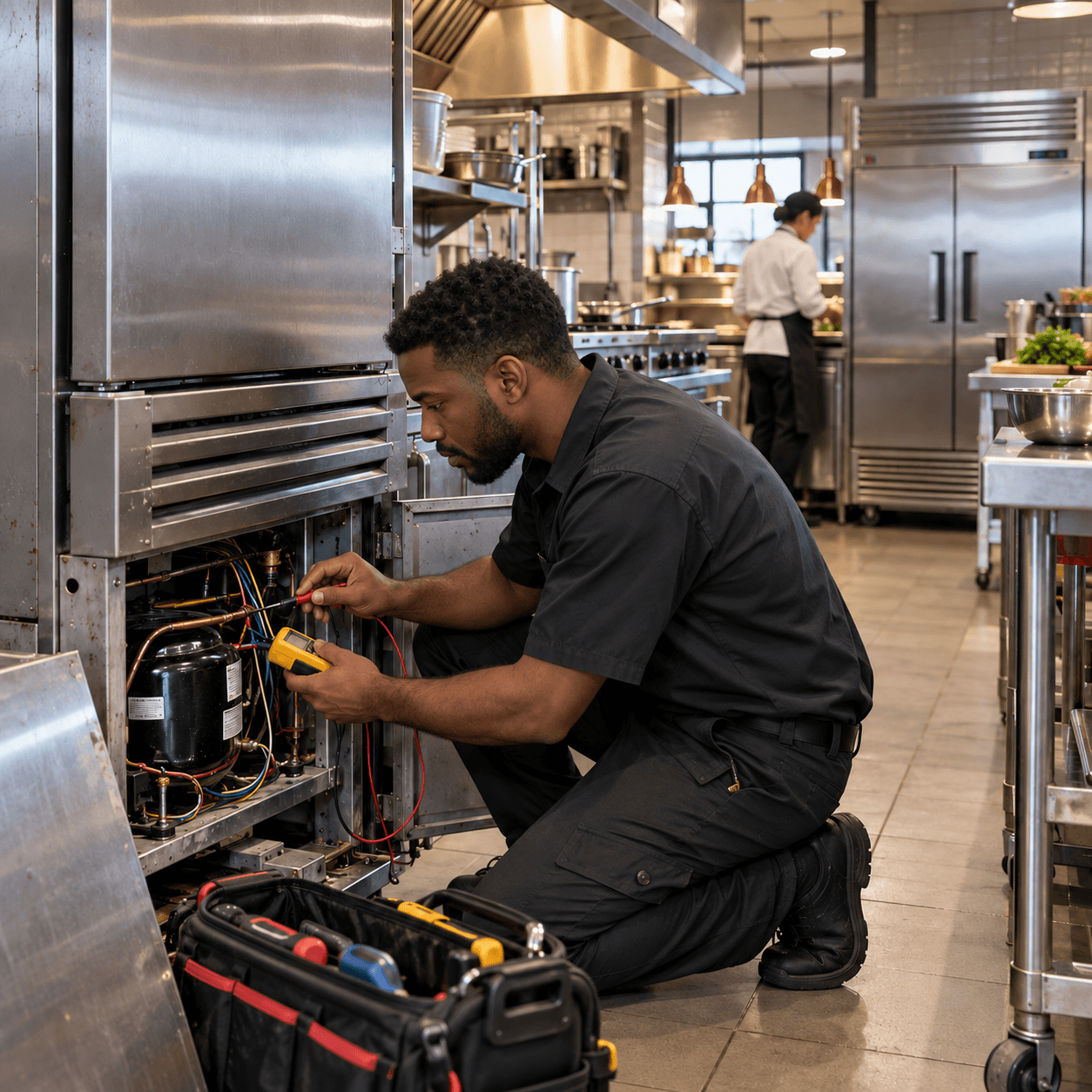
Every commercial kitchen faces this decision eventually. A piece of equipment that has served you well starts acting up, and you are left weighing whether to invest in fixing it or bite the bullet and replace it. It is rarely a simple call. Repair too many times and you end up pouring money into a machine that was never going to last. Replace too soon and you spend thousands on something you did not need to buy yet.
Getting this decision right matters for your budget, your operations, and your peace of mind. The good news is that while there is no single formula that applies to every situation, there are clear principles that make the choice a lot easier to think through. This guide walks through the factors that should drive the repair-versus-replace decision so you can make the call with confidence rather than guessing.
Age of Your Commercial Kitchen Equipment
Age is one of the most important factors in the decision, because it tells you a lot about how much useful life the equipment likely has left. Every piece of commercial kitchen equipment has a general expected lifespan, and where a unit falls within that range should heavily influence your thinking regarding replace vs. repair. A useful way to think about it is where the equipment sits in its life cycle. Early in its life, repair almost always wins. Late in its life, replacement becomes increasingly attractive. In the middle, the other factors in this guide become the deciding considerations.
A relatively new piece of equipment that develops a problem is almost always worth repairing. It has years of service left, the repair restores that value, and replacing it would mean throwing away an asset that has barely begun to pay for itself. On the other hand, equipment that is near or past the end of its expected lifespan is a different story. Repairs on aging equipment tend to buy you less time and are more likely to be followed by additional failures, which shifts the math toward replacement.
Weighing the Cost of the Repair vs. Replace
The most concrete way to approach the decision is to compare the cost of the repair to the cost of replacement. This gives you a clear number to work with rather than a vague sense of whether a repair is worth it.
Use the 50 Percent Rule as a Guideline
A commonly used guideline is the fifty percent rule. If a repair costs more than half the price of replacing the equipment, replacement is often the smarter choice, particularly if the unit is not new. A repair that costs a small fraction of replacement is usually worth it. A repair that approaches or exceeds half the cost of a new unit, especially on older equipment, is a strong signal that your money is better spent on a replacement.
Overall Equipment Condition
It is also worth considering the repair in the context of the equipment’s overall condition. A major repair on a unit that is otherwise in good shape and has plenty of life left can be a sound investment. The same repair on a unit that is likely to need further work soon is throwing good money after bad. The repair cost does not exist in isolation, and thinking about it alongside age and condition gives you a fuller picture.
Consider the Frequency of Breakdowns
A single repair on an otherwise reliable machine is one thing. A pattern of repeated breakdowns is another, and it is often the clearest signal that replacement is the right move.
If you find yourself calling for service on the same piece of equipment repeatedly, the individual repair costs start to add up, and the cumulative expense can quickly exceed what a replacement would have cost. Beyond the money, frequent breakdowns carry hidden costs in the form of downtime, disrupted service, lost product, and the stress of never knowing when the equipment will fail next.
When a machine has become unreliable, replacing it often makes sense even if any single repair seems affordable on its own. The reliability of a new unit is worth something, and a piece of equipment you cannot count on during a busy service is a liability regardless of what the individual repairs cost. If you are keeping a running mental tally of how often a machine breaks down, that tally is telling you something worth listening to.
Factor in Energy Efficiency
One consideration that is easy to overlook is how much the equipment costs to run. Older equipment is often significantly less energy efficient than newer models, and in a commercial kitchen where equipment runs constantly, those efficiency differences add up to real money over time.
Refrigeration is a good example. An older refrigeration unit can consume substantially more energy than a modern, efficient one, and over the course of a year that difference shows up on your utility bills. When you are weighing whether to repair an aging, inefficient unit, it is worth factoring in that a newer replacement could reduce your operating costs enough to offset part of its price over time.
This does not mean you should replace functioning equipment purely for efficiency gains, but when a unit is already a repair-or-replace candidate, energy efficiency can tip the balance toward replacement. A new unit that costs less to run every month changes the long-term math in a way that a repair on an old, inefficient machine does not.
Think About Downtime and Reliability
In a busy commercial kitchen, equipment failures do not just cost money to fix. They cost you during service, and that operational impact deserves real weight in the decision. If a piece of equipment is central to your operation and its failure would bring service to a halt, reliability becomes especially important. An aging unit that is increasingly prone to failure represents a risk to your operations that goes beyond the repair bills. The cost of a breakdown during a busy shift, including lost sales, wasted product, and the scramble to work around it, can dwarf the difference between repairing and replacing.
For critical equipment, the value of reliability is worth building into the decision. Sometimes replacing a unit that could technically be repaired is the right call simply because you cannot afford the risk of it failing at the worst possible moment. For less critical equipment, or equipment you have backups for, you may have more room to keep repairing.
Consider Availability of Parts
An often overlooked practical factor is whether parts for your equipment are still readily available. As equipment ages and models are discontinued, replacement parts can become harder to find, more expensive, or unavailable altogether.
If a repair depends on a part that is difficult to source, you may face long waits for the equipment to be back in service, which compounds the downtime problem. And if parts are no longer manufactured, a repair may not be possible at all, which forces the replacement decision regardless of the other factors. When you are dealing with older equipment, asking about parts availability is a practical step that can clarify the decision quickly.
When Repair Is the Right Call
Repair tends to make sense when:
- The equipment still has useful life remaining.
- The repair cost is reasonable compared with replacement.
- The unit has been reliable, with few previous breakdowns.
- Replacement parts are readily available.
- The repair can be completed within a manageable timeframe.
In these situations, a quality repair can restore a valuable asset and keep your kitchen operating without the larger expense of replacement. A quality repair on equipment that has plenty of life left is one of the most cost-effective decisions you can make. There is no reason to replace functioning equipment that simply needs a fix, and a good repair can extend the useful life of a machine considerably.
When Replacement Makes More Sense
Replacement may be the better investment when:
- The equipment is nearing the end of its useful life.
- A major repair would cost a substantial portion of replacement.
- Frequent breakdowns are driving up service expenses.
- Equipment failures regularly disrupt kitchen operations.
- Essential replacement parts are difficult to find.
- A newer model would offer meaningful operating savings.
For critical equipment, reliability deserves extra weight. If repeated failures interfere with service, continuing to repair the unit may cost more overall than replacing it. The peace of mind and operational stability that come with dependable equipment have real value, and at a certain point that value outweighs the appeal of squeezing a little more life out of a failing machine.
Get a Professional Assessment from Vanco
While these principles give you a solid framework, the repair-versus-replace decision often benefits from a professional evaluation. A qualified technician can assess the condition of your equipment, diagnose the underlying problem accurately, give you a real repair cost, and offer an honest opinion about how much life the unit likely has left.
This matters because the factors in this decision interact in ways that are not always obvious from the outside. A problem that seems minor may point to a larger underlying issue, or a repair that seems major may be straightforward and give you years of additional service. A trustworthy technician will give you the information you need to make the decision that is best for your operation rather than pushing you toward whichever option is more profitable for them.
At Vanco, we help commercial kitchens make these decisions with clear, honest guidance. Whether you need a repair that gets your equipment back in service or an honest assessment of whether a unit has reached the end of its useful life, our team gives you the information you need to make the right call for your operation. If you are facing a repair-or-replace decision and want a professional opinion you can trust, we are here to help.
Frequently Asked Questions About Repairing vs. Replacing Kitchen Equipment
What is the fifty percent rule?
If a repair costs more than half the price of a replacement, replacement is often the smarter call, especially on older units. Treat it as a starting point rather than a hard rule.
How do I know how much life my equipment has left?
The clearest way is to have it assessed by a qualified technician, who can evaluate its condition and give you an honest estimate. Age relative to the equipment’s expected lifespan is a good general indicator, but condition varies based on usage, maintenance history, and the environment it operates in, so a professional evaluation gives you a far more accurate picture than age alone.
Is it worth repairing older equipment?
It depends on its condition and history. A reasonable repair on an older unit that is otherwise in good shape can be worthwhile, but repeated repairs on aging equipment often add up to more than a replacement would have cost. If the unit is near the end of its lifespan or breaks down often, replacement is usually the better long-term choice.
Can newer equipment really save me money on energy?
Often, yes. Older equipment, refrigeration especially, tends to be considerably less efficient than modern models, and in a kitchen where equipment runs constantly those differences add up on your utility bills. When a unit is already a repair-or-replace candidate, the energy savings of a newer model can offset part of the replacement cost over time.
What if I cannot afford to replace equipment right now?
This is a real and common situation. A quality repair can be a reasonable way to extend the life of equipment and buy time, even if replacement is the better long-term move. The key is to go in with clear eyes about the equipment’s condition so you can plan for eventual replacement rather than being caught off guard by a total failure. A technician can help you understand how much time a repair is likely to buy you.
How often is too often for repairs?
There is no exact number, but if you are calling for service on the same piece of equipment repeatedly, that pattern itself is a strong signal. Frequent breakdowns add up in both direct repair costs and the hidden costs of downtime and disruption, and at that point replacement usually makes more sense than continuing to fix an unreliable machine.