
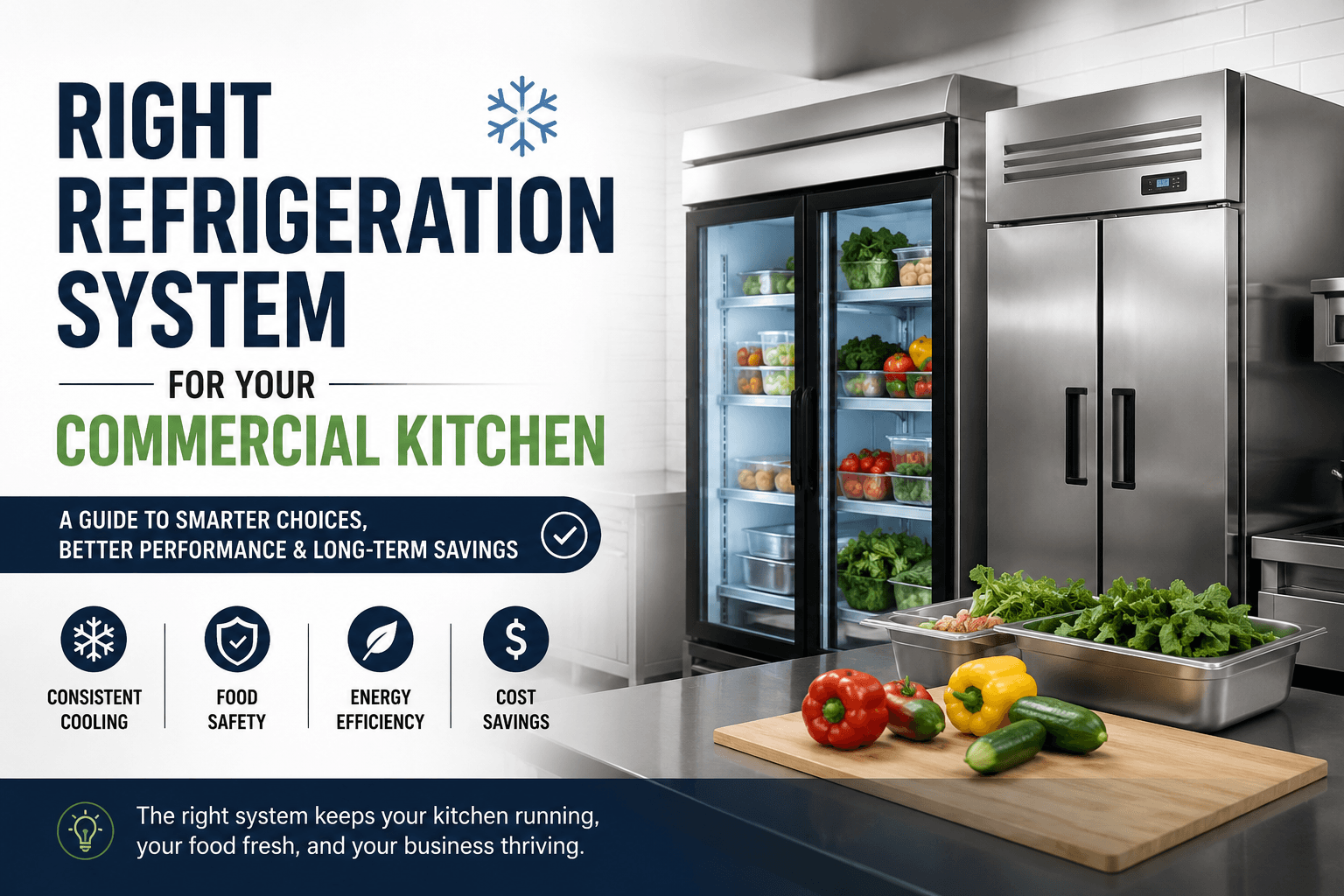
If you run a commercial kitchen, you already know that refrigeration isn’t something you can afford to get wrong. The right system keeps your ingredients fresh, your health inspections clean, and your operation running without a hitch. The wrong one costs you money in energy bills, unexpected repairs, and spoiled products.
The problem is that “refrigeration” covers a lot of ground. Walk-ins, reach-ins, under-counter units, blast chillers, each one serves a different purpose, and what works beautifully for a high-volume restaurant might be completely impractical for a catering company or a hotel kitchen. Choosing the right setup requires a clear understanding of your operation, your volume, and how your kitchen actually flows throughout a shift. Here’s what you need to know before you make a decision –
Start With Your Kitchen’s Actual Needs
Before you look at a single spec sheet, take an honest inventory of how your kitchen operates. How much product do you move on a busy day? How many staff need access to refrigerated items during peak hours? Do you prep everything on-site, or does some of it come pre-made? These questions matter because refrigeration equipment is sized and designed around usage patterns. A unit that’s perfect for a 40-seat diner will be completely overwhelmed in a 200-seat venue and oversized equipment in a smaller kitchen wastes energy and takes up space you can’t afford to lose.
Think about your menu, too. A kitchen that works primarily with proteins has different cold storage demands than one that’s heavy on produce or dairy. The type of food you store affects everything from the temperature range you need to how often your staff will be opening and closing doors.
Types of Commercial Refrigeration Systems
Walk-In Coolers and Freezers
Walk-in units are the backbone of most high-volume commercial kitchens. They offer serious storage capacity and make it easy to organize large quantities of product efficiently. If your operation receives regular bulk deliveries or does significant prep work in advance, a walk-in is usually non-negotiable.
Walk-ins come in both cooler and freezer configurations, and many kitchens use both. They can be installed as standalone units or combined into a single structure with separate temperature zones. One thing to keep in mind: walk-ins require thoughtful placement within your kitchen layout. You need enough clearance for staff to move in and out with sheet pans and full cases, and the compressor system needs proper ventilation to run efficiently.
Maintenance on walk-ins is also something to plan for. Door seals, evaporator coils, and condensate drains all need regular attention. A small issue in a walk-in can quietly compound into a major equipment failure if it goes unaddressed.
Reach-In Refrigerators and Freezers
Reach-ins are the workhorses of the line. They give your cooks quick, direct access to ingredients without requiring anyone to leave their station, which keeps service moving. Most commercial kitchens use a combination of reach-in coolers and freezers positioned strategically along the line based on what’s being prepared in each station.
When evaluating reach-ins, door configuration matters more than people expect. Full-door units maximize capacity but can be awkward in tight spaces. Half-door models or glass-door units are better suited for high-traffic areas where staff need to grab items frequently without holding the door open for extended periods. Glass doors also help with organization, your team can see exactly what’s where without a full door swing every time.
Under-Counter Refrigeration
Under-counter units fit neatly beneath prep surfaces and are a smart choice for kitchens where floor space is limited or where specific stations need dedicated cold storage. A sauté station, for example, might have an under-counter unit stocked with prepped proteins and sauces so the cook doesn’t have to move away from their position during service.
These units are compact by design, which means they have smaller compressors and more limited capacity. They work best as a complement to larger walk-in or reach-in systems, not as a primary storage solution for a busy kitchen.
Blast Chillers
Blast chillers serve a different function than standard refrigeration, they’re designed to rapidly reduce the temperature of hot food. This matters for food safety, since moving food through the danger zone (between 40°F and 140°F) quickly reduces bacterial growth. It also matters for quality, since rapid chilling preserves texture and flavor better than slow cooling.
For kitchens that do significant batch cooking, prep-ahead cooking, or catering work, a blast chiller is often worth the investment. It also allows kitchens to extend prep windows and hold food more safely over longer periods, which adds operational flexibility.
Refrigerated Prep Tables
Common in sandwich and pizza operations, refrigerated prep tables keep ingredients at safe temperatures right at the point of use. The ingredients sit in cold wells directly in the work surface, so your prep cooks aren’t constantly reaching into separate units during service. For certain kitchen concepts, these tables significantly improve speed and efficiency on the line.
Key Factors to Evaluate Before You Buy
- Capacity and Storage Volume
Measure your actual space and work backward from there. It sounds obvious, but many kitchens end up with units that are slightly too large or too small because they estimated rather than measured carefully. Leave room for airflow around the unit — refrigeration equipment needs clearance to operate efficiently, and cramming a unit into a tight corner is one of the fastest ways to shorten its lifespan.
- Energy Efficiency
Commercial refrigeration runs continuously, which means energy costs add up fast. Look for units with ENERGY STAR certification and pay attention to the compressor type. Modern variable-speed compressors use significantly less energy than older fixed-speed models because they adjust output based on demand rather than running at full capacity all the time. The upfront cost of a more efficient unit is often recovered in utility savings within a few years.
- Temperature Consistency and Recovery Time
A refrigerator that holds a steady temperature when the door stays closed but struggles to recover after a busy service rush is a problem waiting to happen. Look at the recovery time specs — how long does the unit take to return to set temperature after a significant temperature fluctuation? In a busy kitchen, doors open and close constantly, and a unit with poor recovery time will cycle through temperature ranges that compromise food safety and product quality.
- Ease of Cleaning and Maintenance
Health code compliance requires that your refrigeration equipment be kept clean, and some units make that significantly harder than others. Look for interiors with minimal crevices, removable shelving, and coated surfaces that resist bacterial growth. Self-cleaning condensers are worth the extra cost in a high-volume environment because they reduce the maintenance burden on your staff.
- Compressor Location
Top-mounted compressors are easier to access for service and stay cleaner in environments where floor debris is an issue. Bottom-mounted units can be more compact but tend to accumulate grease and debris around the compressor, which increases maintenance demands and can shorten equipment life in a busy kitchen.
Common Mistakes to Avoid
One of the most frequent mistakes kitchens make is treating refrigeration as a one-size-fits-all purchase. Buying the cheapest unit available or replicating what a previous location used without evaluating current needs almost always leads to problems down the road.
Another common issue is underestimating how much the equipment’s placement matters. A reach-in positioned at the wrong end of a kitchen forces staff to take extra steps during service, which slows everything down. A walk-in with a compressor that vents heat into an adjacent prep area creates problems that weren’t anticipated at installation.
Finally, deferred maintenance is one of the biggest culprits behind premature equipment failure. Refrigeration systems give warning signs before they fail, unusual sounds, inconsistent temperatures, condensation in the wrong places, and those signs are easy to ignore when a kitchen is busy. Catching small problems early is almost always cheaper than a full breakdown during service.
When to Call a Professional
If your existing refrigeration equipment is underperforming, running constantly, struggling to hold temperature, or making noise it wasn’t making before, those are all signs worth taking seriously. A qualified technician can often diagnose and address issues before they escalate into a full replacement situation.
Choosing new equipment is also a good moment to bring in professional guidance. An experienced commercial kitchen refrigeration technician can help you evaluate your current setup, identify gaps, and recommend units that are properly sized and configured for your specific operation, which saves money and headaches in the long run.
Frequently Asked Questions About Commercial Refrigeration Systems
How do I know what size refrigeration unit I need?
Start with your storage volume, how much product you need to hold at any given time, and work from there. As a general rule, you want enough capacity to hold your full par level with some buffer, and you should account for how often deliveries come in. A kitchen that receives daily deliveries can get by with less storage than one that stocks up twice a week. When in doubt, consult with a commercial equipment specialist who can evaluate your actual kitchen and workflow.
What’s the difference between a reach-in cooler and a walk-in cooler?
The main difference is capacity and accessibility. Walk-ins offer much larger storage volume and are designed for holding bulk product. Reach-ins are positioned along the line for quick access during service and hold smaller quantities of prepped or frequently used ingredients. Most commercial kitchens use both, the walk-in for primary storage and reach-ins for what’s actively in use on the line.
How often does commercial refrigeration equipment need to be serviced?
A preventive maintenance visit at least twice a year is a reasonable baseline for most commercial refrigeration equipment. High-volume kitchens or units that run in hot ambient environments may benefit from more frequent service. Filters and coils should be cleaned regularly depending on how much grease and particulate is in the air around the unit.
What temperature should a commercial refrigerator maintain?
Commercial coolers should maintain temperatures at or below 41°F, which is the threshold set by most health codes to slow bacterial growth. Freezers should hold at 0°F or below. It’s worth investing in a monitoring system that alerts you if temperatures drift outside of safe ranges, especially for units that hold significant product value.
Is it better to repair or replace aging refrigeration equipment?
It depends on the age of the unit, the nature of the repair, and how well the equipment has been maintained. As a general guideline, if a repair costs more than 50% of the unit’s replacement value and the equipment is already toward the end of its expected lifespan, replacement is often the smarter investment. A technician can help you evaluate whether the underlying system still has reliable life left in it.
What causes commercial refrigerators to fail prematurely?
The most common causes are lack of preventive maintenance, poor ventilation around the unit, overloading the system beyond its designed capacity, and ignoring early warning signs. Dirty condenser coils force the compressor to work harder, which accelerates wear. Damaged door gaskets allow warm air infiltration, creating the same problem. Staying on top of basic maintenance dramatically extends equipment life.